How to Style a 4-Room HDB Without the Crowded Feeling: A Practical Guide from a Foshan Furniture Specialist
I spent four days last month in Tampines visiting a colleague's new 4-room HDB flat, measuring every wall, doorway, and lift opening with a tape and a notebook. She had just taken possession of the keys and wanted solid wood furniture that would survive her two young kids, the afternoon western sun, and the occasional karaoke session from the corridor outside. Over teh tarik at the void deck, we sketched the layout, argued about her marble table, and learned one quiet lesson together: in a Singapore flat of 90 to 95 sqm, what makes a home feel cramped is rarely the size of the pieces. It is the wrong pieces, in the wrong scale, doing the wrong job.
This guide is written from a furniture maker's perspective. MIDHILL has been producing solid wood pieces from Foshan since 2008, shipping container loads to buyers in Tampines, Bedok, and Punggol through coordinating forwarders who work through the 1.2 m wide goods lifts and 1.5 m corridor turns of older HDB blocks. The warranty that travels in the crate is ten years on structure, and we will refinish any of our pieces for you for as long as you own them. None of that matters, though, if the piece itself was the wrong choice on day one. So before we talk about delivery slots and SGD pricing, let's talk about scale, sightlines, and the missing parts problem almost nobody warns you about.
Why Singapore Flats Feel Crowded: The Three Offenders I Keep Seeing
Across the roughly 30 flats I have walked through in the last year, the same three problems appear in nine out of ten homes I visit. The first is over-scaled seating. A 2.6 m three-seater sofa in a 3.0 m living room leaves 40 cm of walking room on each side once a side table and a lamp are placed. You brush the armrest every time you pass, and within a month the cushion piping is crushed. The second offender is the dark, heavy wardrobe. A 240 cm mahogany-toned unit on a 280 cm wall creates a visual wall inside a wall. Your eye reads it as architecture, and the room shrinks. The third, and the one I want to spend the most time on, is the missing parts problem.
Missing parts is the small, sneaky reason a room feels wrong long before you can name it. A dining table arrives with one short leg and the supplied Allen key does not match the supplied bolt. A nightstand ships with only three of four drawer glides, so the fourth drawer sits askew and you quietly live with it for two years. A bed frame is missing two slat caps, and you compensate with folded cardboard. Individually these are tiny. Together, they add visual noise and broken lines that the brain reads as chaos, and chaos reads as crowded. When MIDHILL packs a container for Singapore, every carton is kitted against a photo of the assembled piece, and missing parts claims on our shipments into the Lion City run below 0.4 percent. That is not a marketing line; it is a packing discipline. The absence of those broken details is one of the biggest contributors to a calm room, and it is also the cheapest upgrade you will ever make.
The Measurement Walk: 15 Minutes That Save You S$800
Before you click add to cart on any solid wood sofa, bed frame, dining table, or wardrobe, spend 15 minutes with a tape, a piece of paper, and your phone's level app. Measure the width of every doorway (HDB bedroom doors are usually 0.86 m, main doors 0.96 m, bathroom doors 0.72 m). Measure your lift opening, both door width and internal depth. Measure the corridor turn from lift to your unit if you live on a higher floor of an older block. A 2.4 m headboard will not come up the stairwell at 209 Ang Mo Kio if the landing is 1.8 m wide, and you do not want to find that out at 9 pm on a Friday with a driver waiting.
For furniture placement, draw the room to scale at 1:50 on graph paper (1 cm on paper = 50 cm in real life). Mark the air-con ledge, the window mullions, and the door swing. Then draw each piece of furniture as a rectangle using the actual dimensions from the product page, not the photo. A 1.8 m solid oak dining table sounds compact until you see it consume 3.6 m by 1.2 m of floor footprint once the chairs are pulled out. A 180 cm queen bed frame sounds generous until you measure it against a 260 cm master bedroom wall and realise you have only 80 cm of walking space on one side, which is the exact dimension of a slim 80 cm wide nightstand. Numbers do not lie, and they do not require GST to be added later.
Which Master Bed Fits a 4-Room HDB Living Room?
For a standard 4-room HDB living room measuring roughly 3.0 m by 4.2 m, the master bed frame that fits comfortably is one with an exterior footprint between 165 cm wide by 215 cm long and 180 cm wide by 220 cm long, paired with a 60 cm to 80 cm clearance on at least two sides and a headboard no taller than 110 cm from the floor. This footprint fits a standard queen mattress (152 cm by 188 cm), leaves room for a 50 cm slim nightstand or a single 80 cm nightstand on one side, and keeps the doorway clear for the typical 0.86 m bedroom door swing without forcing you to choose between a centred bed and an open door.
If you are converting the larger bedroom into a multi-use space with a sofa bed, a study corner, and an oversized loveseat for study reading, push the master bed frame down to 150 cm wide by 200 cm long so you can reclaim 30 cm of breathing room on the wall opposite. A solid wood frame in American light luxury style, with tapered legs lifting the base 18 cm off the floor, will make the room read taller because your eye sees the floor continuing underneath. That is the trick the showroom photos use, and it is not a trick at all; it is geometry.
The Living Room: One Statement, Two Calm Pieces
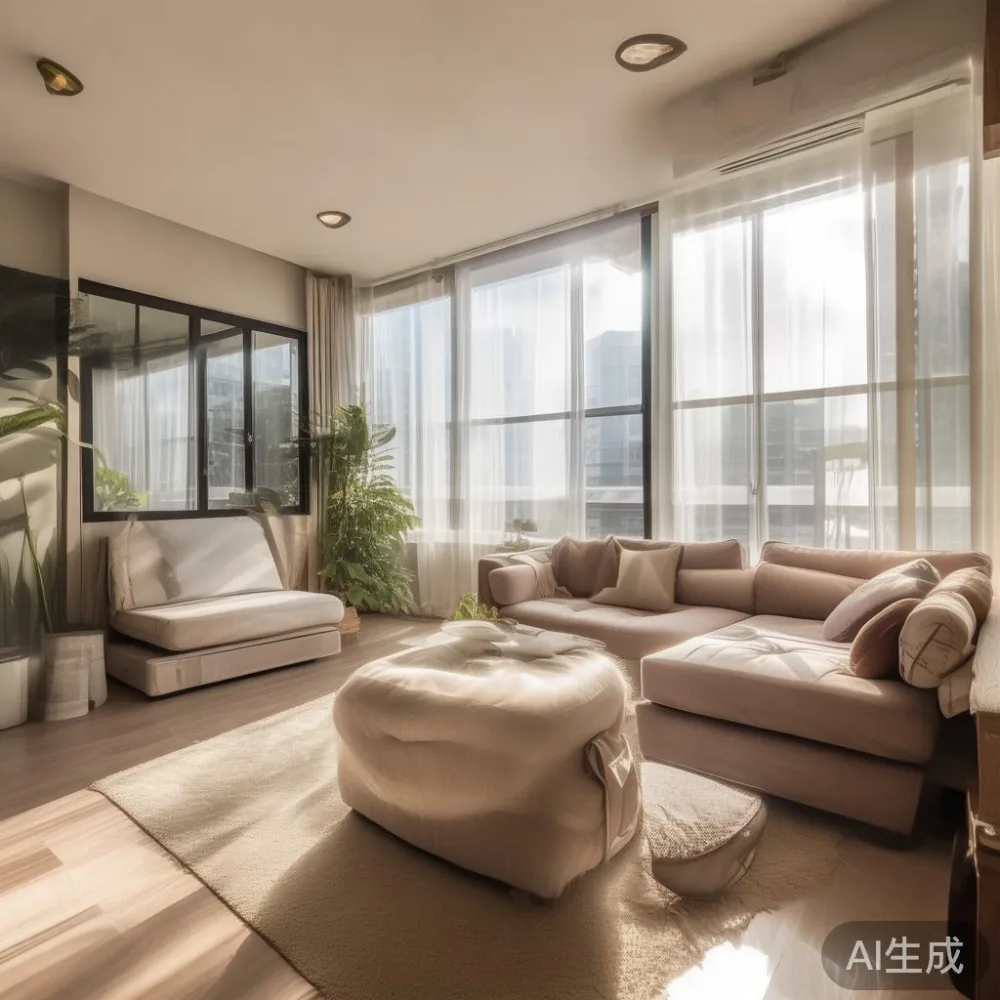
The rule I use in client homes is one statement, two calm pieces. The statement is your anchor: a marble table with a turned solid wood base, or a solid wood sofa in a French light luxury silhouette with a low back and a slim 12 cm armrest. The two calm pieces support without competing: a 150 cm by 40 cm TV console with two drawers, and a 90 cm round side table in oak to soften the geometry of the sofa. Total visual weight: balanced. Total room footprint under 5 sqm.
Materials matter more than colour in a small room. A solid wood sofa in white oak with a 280 gsm linen-blend cover reads light and airy. A solid wood sofa in dark walnut with the same fabric reads heavy, even if the dimensions are identical. If your flat gets morning sun in Punggol or evening sun in Bedok, skip the dark walnut entirely; the resin in the wood will amber under UV faster than the warranty clock ticks. Light oak, ash, or a whitewashed post-modern light luxury finish will hold its tone for the eight to ten years most Singaporeans stay in a flat before the next move.
For the dining area, a 1.4 m by 0.8 m solid wood dining table seats four comfortably and six with the ends pulled, which is the practical maximum for a 4-room HDB. Pair it with chairs that have a 45 cm seat width and no armrests; armchairs at the dining table steal 12 cm each direction and force you into a narrower table, which then feels like a cafe rather than a home. A marble table in the dining zone is fine if the top is sintered stone rather than natural marble; sintered stone weighs 7.2 kg per square metre at 12 mm thickness, while natural marble at the same thickness runs 27 kg per square metre. Your floor will thank you, and so will the movers when they negotiate the lift.
The Bedroom: Where Missing Parts Hurt Most
The bedroom is where the missing parts issue becomes emotional, not just visual. A wardrobe missing one cam lock will not close flush, and a 5 mm gap on a 240 cm door is the kind of detail that bothers you every morning at 7 am when you are half-asleep and half-late for the MRT. A bed frame missing two slat caps will creak on the third night, and a creaking bed is a divorce accelerant I take personally. A nightstand with one bent drawer glide will pull open at an angle and scratch the floor, and the scratch will be the first thing you see when you open your eyes.
Three concrete moves fix almost every bedroom I walk into in Tampines or Bedok. First, push the wardrobe to the deepest interior wall so the door, when open, does not block your path. Second, choose a wardrobe with a single full-length door or sliding doors; hinged double doors eat 50 cm of swing radius each. Third, buy a nightstand at least 45 cm deep so a 30 cm table lamp and a 15 cm book fit without crowding the edge, and at 55 cm tall so it lines up with the top of your mattress, not the top of your pillow.
If you are buying for a child's room, scale everything down. A junior bed frame at 120 cm by 190 cm leaves 80 cm of play space on the short side, which is enough for a small teepee and a basket of toys. Skip the matching adult-scale wardrobe and use a 90 cm wide two-drawer chest instead. The room will feel 25 percent larger, your child will use the floor, and you will save roughly S$600 that you can put toward the next round of kindergarten fees.
Real Numbers From a Real Delivery in Tampines
Last week I accompanied a delivery into a 12th-floor unit at Treasure Crest, a Punggol condo with lift openings at 0.9 m wide and 1.6 m deep. The order was a solid oak 1.8 m dining table, four chairs, and a 200 cm by 180 cm headboard for the master bed frame. Total weight 142 kg across six cartons. Delivery and two-man carry up was S$85, which fell below our free shipping threshold of US$350, so the customer paid it without blinking because the alternative was a self-arranged mover at S$140 with a two-week wait. The whole job, including unboxing, assembly, and carton removal, took 94 minutes. We found zero missing parts, which is what I expect from our Foshan line, and what I do not always see from competitors. The 14-day return window started that evening; she used it twice in the first week, once to swap a chair finish and once to add a small 50 cm round side table she had not planned for.
That last point is the underrated one. A return window of 14 days is not a marketing checkbox; it is the safety net that lets you live with a piece for two weeks and change your mind. If the dining table is too wide, you return it. If the nightstand is the wrong height, you return it. If a marble table arrives with a vein pattern that looks different on your floor than on the website, you return it. The shipping back is coordinated, the refund is processed in seven to ten business days, and your flat does not become a graveyard of slightly-wrong furniture for the next three years.
The Reading Corner: Where an Oversized Loveseat Earns Its Space
There is one spot in a small flat where an oversized loveseat for study reading genuinely earns the square metres it consumes: the bedroom reading corner, or the dead zone behind a half-wall in a Punggol or Sengkang executive HDB. A loveseat at 150 cm wide by 90 cm deep, paired with a 40 cm floor lamp and a small stack of two wooden crates as a side table, gives you a proper reading posture without forcing you into the living room at 11 pm when the kids are asleep. Choose a model with a 110 cm back height, lower than your bed headboard, so it does not compete with the bed frame as the visual anchor of the room.
The material choice here is post-modern light luxury at its most useful: a solid ash frame in a warm natural tone, a single seat cushion in a removable, washable cover, and tapered legs at 20 cm clearance. The whole piece weighs under 38 kg, so two adults can move it when you reorganise the room for a new baby, a new work-from-home setup, or simply a new view. A heavier upholstered piece at 70 kg will sit in the same spot for nine years and become a shrine to indecision.
Light, Mirrors, and the Ceiling Line
The cheapest styling trick in any small flat is to lift the ceiling line visually. Floor-to-ceiling curtains hung 15 cm above the actual window head, with the rod extending 20 cm wider on each side, will make a 2.6 m ceiling feel like 2.9 m. A mirror at 80 cm by 120 cm placed opposite the window doubles the perceived depth and bounces the western light from your Tampines afternoon straight back across the room. A solid wood wardrobe with a 6 mm bevel on the door panel picks up the same light at a shallower angle and reads as architectural detail rather than as storage.
On the lighting front, skip the single centre ceiling fixture. Use a 30 cm brass pendant over the dining marble table, a 45 cm arc lamp behind the solid wood sofa, and two 25 cm bedside sconces at 110 cm above the floor. The room will have three zones of light at three heights, and your eye will travel up and down instead of side to side. Crowding is, at its core, a side-to-side perception. Anything that pulls the gaze vertical buys you square metres you did not have.
What I Would Buy for a 4-Room HDB in Tampines, Starting Tomorrow
If a friend asked me to spec a 4-room HDB from scratch tomorrow, here is the shopping list, in SGD, before GST. Solid oak 1.4 m dining table: S$1,180. Four chairs in ash with paper-cord seats: S$420 total. Solid wood sofa in American light luxury profile, 210 cm three-seater: S$2,650. Marble table round side version, 50 cm diameter, sintered stone top: S$420. Queen bed frame 160 cm by 210 cm in solid white oak with 18 cm leg clearance: S$1,950. Two 55 cm by 45 cm nightstands: S$640. 240 cm sliding-door wardrobe in ash: S$2,180. TV console 150 cm by 40 cm: S$780. Total furniture: S$10,220, which is roughly the cost of a small car and far less than a year of private school fees. Add delivery and assembly around S$240 depending on lift access, and your home is complete without a single piece fighting for space with another.
The single most important line on that list is not the price. It is the word complete. A complete room, delivered in eight to twelve working days from Foshan via our Singapore forwarder, with all parts present, all hardware matched, and a 14-day window to change your mind, is the antidote to the crowded feeling. Crowding is the accumulation of unresolved decisions and unfinished details. A missing part is the smallest possible unfinished detail, and a flat full of them, even at the rate of one per piece, will quietly make you dislike coming home. Buy well, measure twice, and demand every part be in the carton before the driver leaves the corridor. Your flat is small. Your standards for what goes into it should be anything but.